
Enquiry only
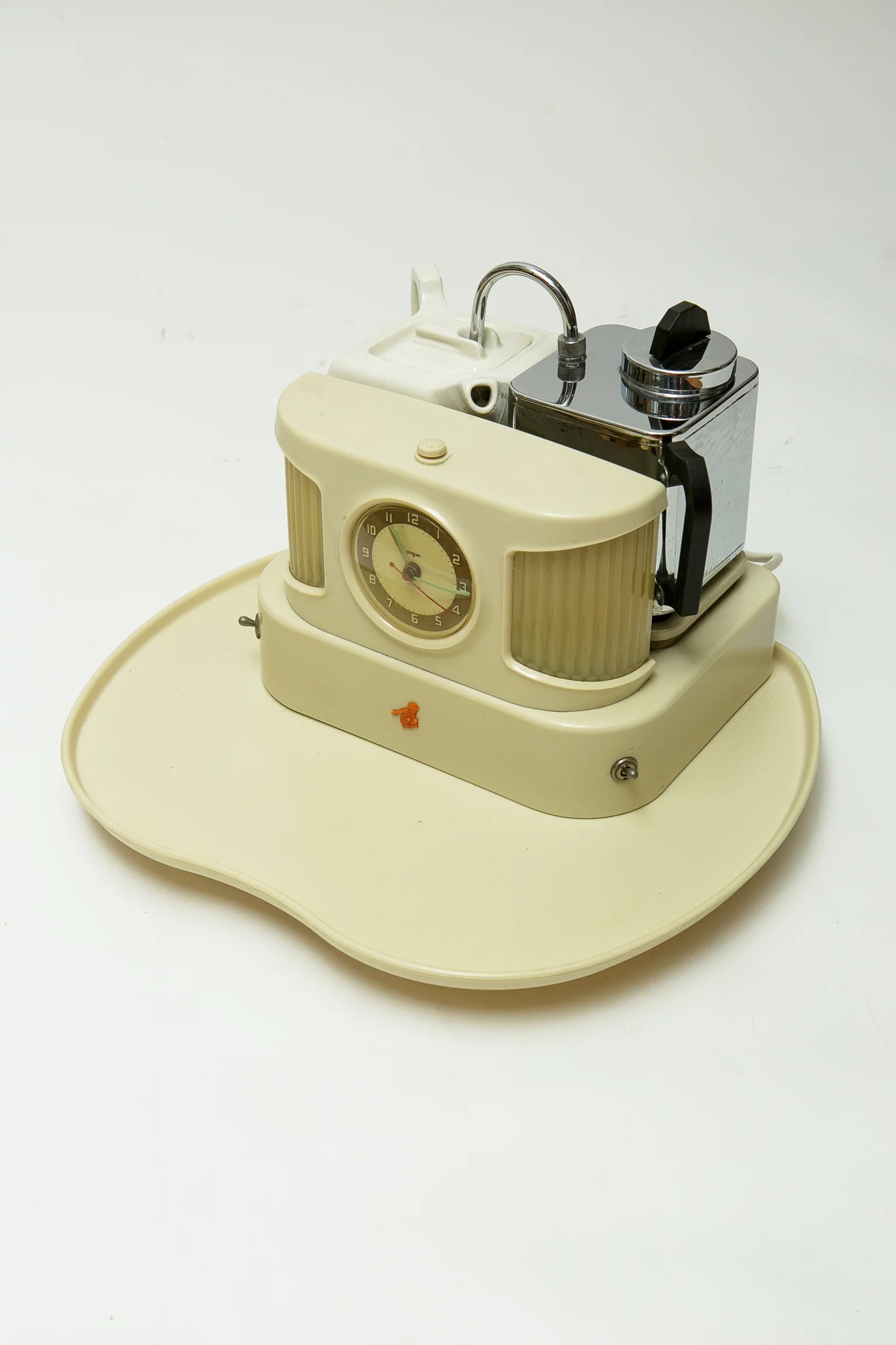
1950s ‘Goblin Teasmade’ tea maker
Price on request
The Golden Age Of The Teasmade
Between 1890 and 1910, inventions such as the motorised vacuum cleaner and the electric toaster were developed and became commercially successful. At the same time, travel and transport were bringing the world closer together, with goods moving back and forth in ever greater quantities.
Throughout the 19th century the UK’s tea consumption increased and tea became affordable to even the poorest. Since the turn of the 20th century, Britain has remained one of the world’s most voracious per-capita consumers of tea.
The early 20th century also saw domestic electricity bringing big changes in home technology. By the end of the 1930s, two-thirds of British homes had electricity, which meant an automatic cup of tea no longer involved sleeping next to an open flame.
Conditions were ideal for this very British invention to take off. Automatic tea-makers became ‘Teasmades’, made accessible by the new electricity supply.
In 1936, one of the first to be commercially produced was the Goblin Teasmade with its Art Deco curves, side lights and large clock. Early models included a lamp as well as a kettle, and some are known to have had radioactive radium paint on their clock faces, which made them glow in the dark.
Goblin, part of the British Vacuum Cleaner & Engineering Company (the domestic appliance company founded by Hubert Cecil Booth, inventor of the vacuum cleaner) became the most established name in the market.
The ‘Teasmade reached its greatest popularity in the 1960s and 1970s – when it was at the top of many wedding-gift lists – but then fell out of fashion. Recently, there has been an interest in retro devices, and the bedside companion loved by generations of Brits is now an object of cool!
This iteration of the Teasmade was so ubiquitous that it featured prominently in the video for Queen’s 1984 single ‘I Want to Break Free’, waking (and burning) guitarist Brian May.
A mid-century icon, the Teasmade—an automatic tea-maker and alarm clock—now has enormous nostalgia value and has a prominent place in the Science Museum in London!
For large pieces, delivery or collection is arranged separately. Ask for an estimate before purchasing.